For restaurants with their own riders
Every offer arrives with the route already drawn
DriverVue is the app your own delivery riders carry. Orders come only from your kitchen, so there is no bidding, no acceptance score and no competing restaurants. A live map fills the screen, the sheet rises and falls with the job, and above 5 mph the screen simplifies itself.
No shift scheduling
a rider is dispatchable from the moment they log in and go online
Live position to your dispatch
location streams back to the back office, in foreground and background
Dark by default
built for night work, with a daylight theme that is designed rather than inverted
The core of it
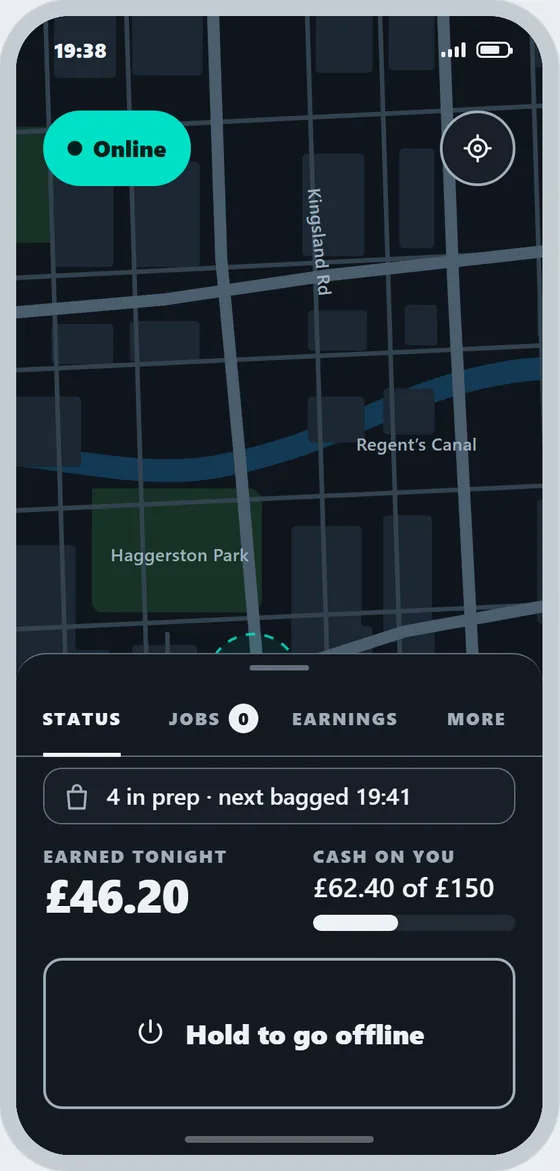
Signing in puts the rider on duty
There is no shift to schedule and no zone to pick, because one restaurant has one zone. The rider signs in, confirms they are online, and dispatch can reach them.
- 1No shift scheduling
a rider is dispatchable from the moment they log in and go online
- 2Live position to your dispatch
location streams back to the back office, in foreground and background
- 3Dark by default
built for night work, with a daylight theme that is designed rather than inverted
Features
What DriverVue does during service.
The route is drawn before they accept
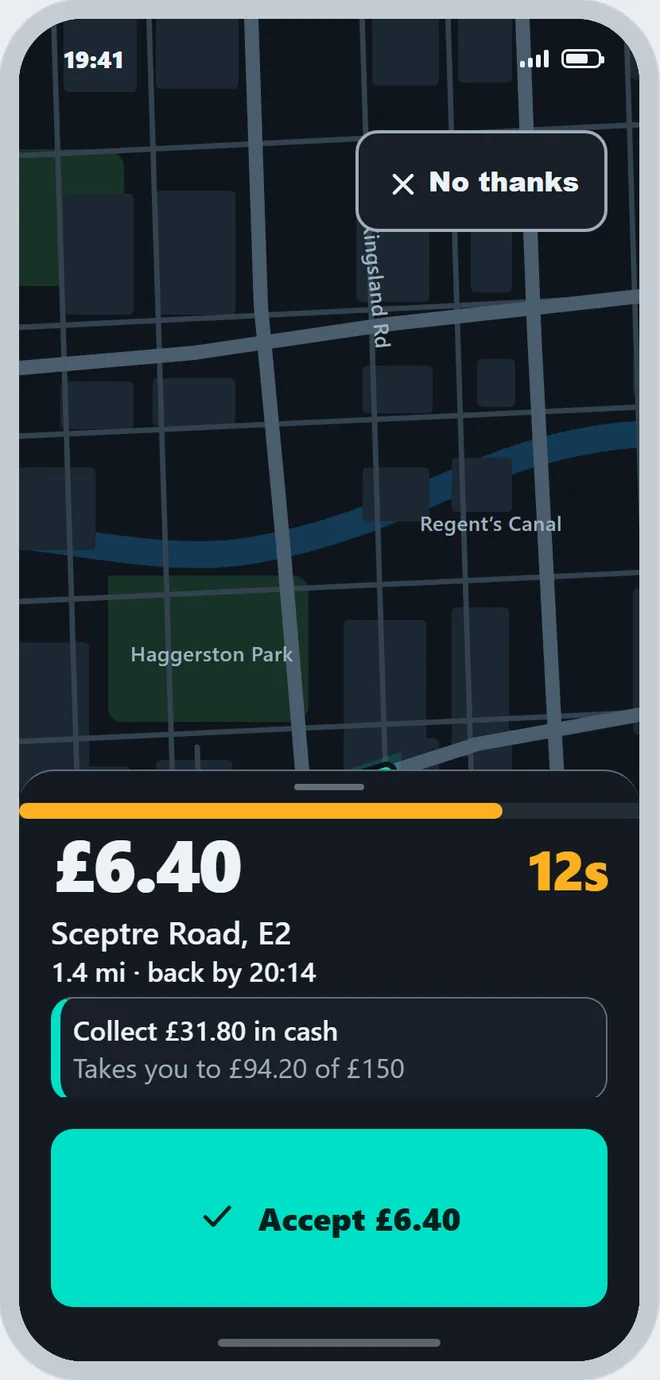
An offer arrives as a card over the live map with the 1.4 miles already drawn on it. A rider reads a shape faster than a list of fields, and the shape answers a question a list cannot: does this go the wrong way at chucking-out time? Five facts sit beside it — the payout, the countdown, the street
- Payout stated up front — one exact number, with no "total may be higher" hedge
- Cash exposure before they commit — "Collect £31.80 in cash · takes you to £94.20 of £150"
- No kitchen block — your name, address and phone are identical on every job, so the screen does not repeat them
Above 5 mph the screen steps back
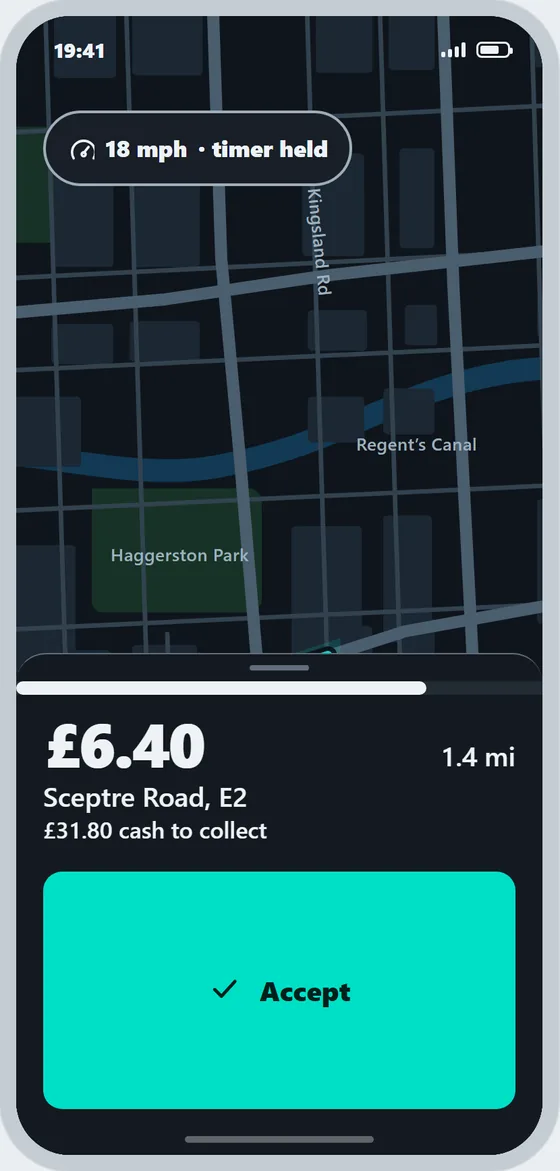
On a bike the right hand is throttle and front brake and the left is clutch, so there is no free hand. Above 5 mph DriverVue takes things away. Three facts survive on an offer — the money, where it goes, and whether it is cash — and the freed space goes into the accept bar
- The timer holds, it does not expire — for up to 90 seconds of continuous movement, after which the job returns to the pass
- Returned, not declined — the rider is told in plain words, and nothing is counted against them
- The alert is audio first — a short tone that ducks other audio, plus a spoken line through a paired intercom
Accept is a tap with an undo
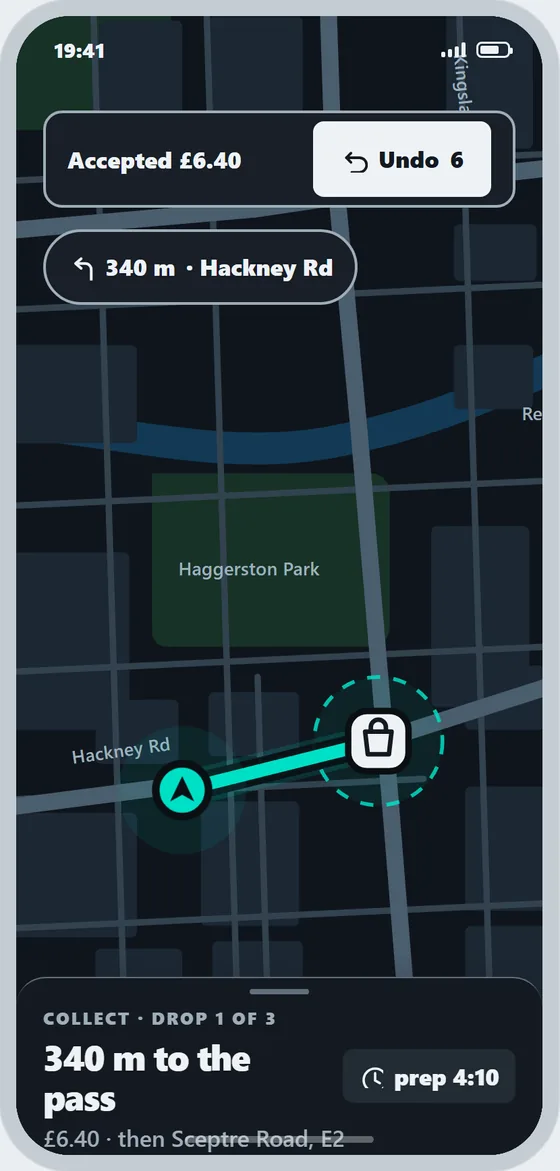
A confirm dialog taxes every rider who did the right thing in order to catch the one who did not. DriverVue reverses that. The accept bar is inert for a moment after the card appears, touch-down and touch-up must both land inside it
- Four stages, one action each — Kitchen, Collect, Ride, Hand over, with the current stage always on screen
- The sheet is the navigation — it rises and falls with the job, and the map is never replaced by another screen
- Multi-drop drawn, not listed — numbered pins show which drop is farthest, which three due times in a list cannot
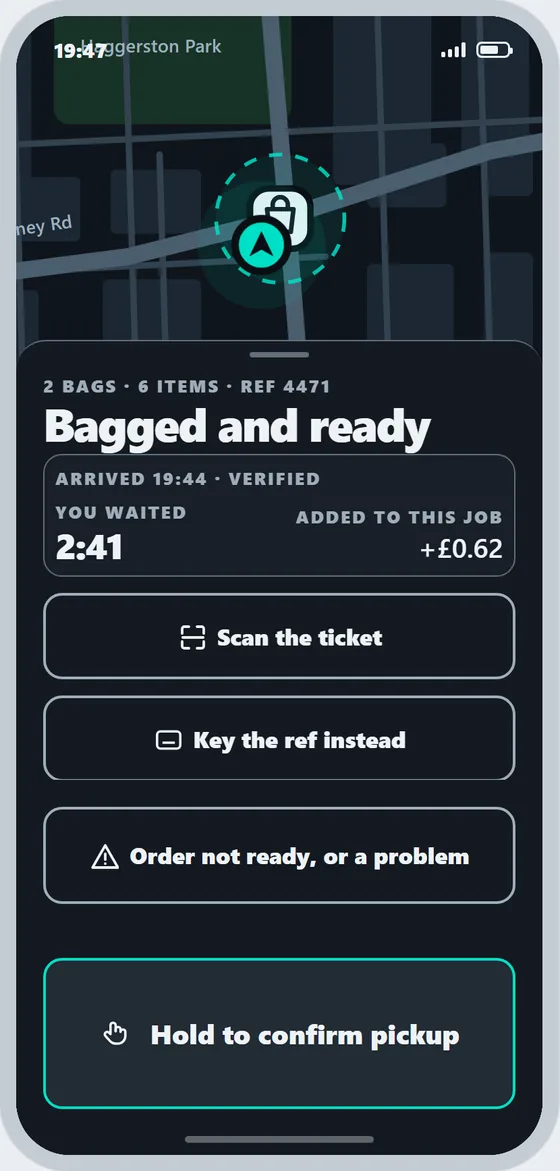
Waiting at your pass is measured and paid
Arrival at the kitchen is verified by a geofence rather than self-reported, so the clock starts when the rider actually gets there. If the food is not ready, the wait runs on screen next to the money it is earning — 2:41 and 62p, credited against this job rather than buried in a weekly statement.
- Bags and items, not prose — "2 bags · 6 items · ref 4471" is the whole handover from your kitchen
- A prep countdown — the rider sees how long the kitchen has left before the order is bagged
- Wait time shown as it accrues — and it appears again on the earnings screen as its own line, not folded into a total
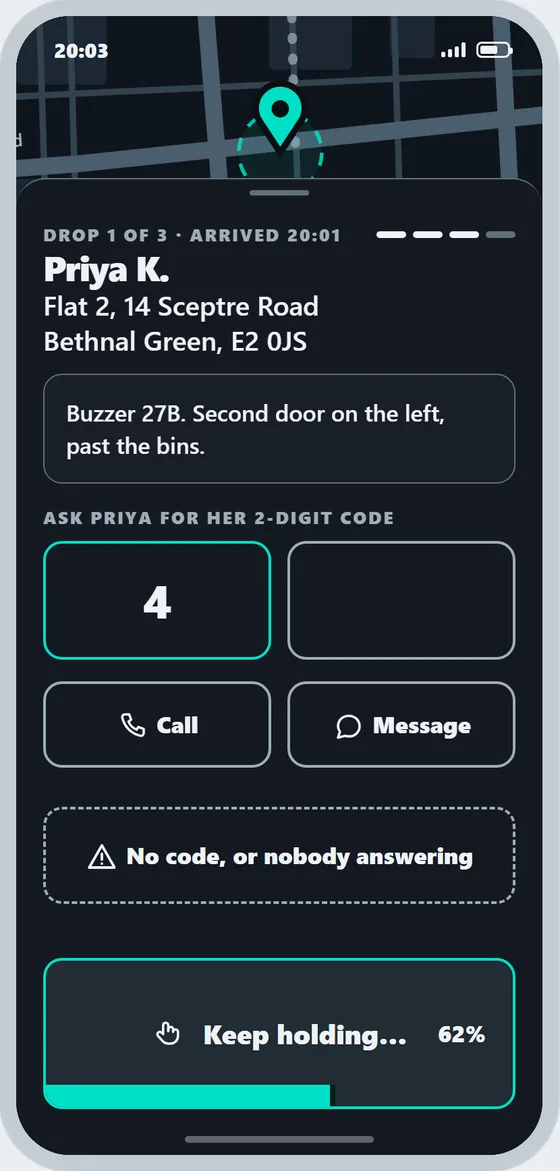
In depth
Two digits prove the drop-off
At the door the map has said everything it can, so the sheet rises to full and covers it. The customer's name, flat, full address and access note appear in one block, and the note is printed in full and in neutral type, because an instruction is not an emergency. The rider then asks for a two-digit code: short enough to read aloud and type one-handed in the rain, long enough to prove someone was there. Marking the order delivered is a hold that fills rather than drains, and it cannot be submitted twice.
- 1Change worked out for them
the amount to collect and the change to give back are on screen, so there is no arithmetic at the door
- 2Call and message in-app
riders and customers coordinate without exchanging phone numbers
- 3A time-gated escape route
"no code, or nobody answering" opens a ladder: canned message first, calling at 30 seconds, leaving in a safe place only after seven and a half minutes
Specifications
The hard facts.
- Platforms
- Native iOS and Android from one codebase, plus a browser build for demos
- Fleet model
- One restaurant's own riders; no bidding, no acceptance rate, no cross-restaurant dispatch
- Guided stages
- Four: Kitchen, Collect, Ride, Hand over, with one clear action at each
- Proof of delivery
- Two-digit handover code, optional photo, GPS fix and timestamp; guarded against a double tap
- Cash handling
- Change calculated at the door, running float shown against a cap, cash orders paused at the cap
- Themes and languages
- Dark by default with a separately designed daylight theme; fully translatable, right-to-left supported
What it's worth to you
Why this matters commercially.
Keep the customer, keep the margin
Your own riders on your own app means the delivery, the data and the customer relationship stay with your restaurant, rather than being rented back from a marketplace every week.
Cash you can account for
Every rider's float is visible against a cap, change is calculated for them, and cash orders stop being dispatched once they hit the limit, so nobody carries more than you agreed.
A defensible record of every drop
A handover code, a GPS fix, a timestamp and, where needed, a photograph of the place, so a "never arrived" call is settled from the record instead of argued.
DriverVue questions
Asked on the first call.
Do we need our own riders, or does this work alongside a marketplace?
DriverVue is for your own fleet: riders you employ or contract and provision yourself, rather than people who sign themselves up. It only ever shows orders from your restaurant, and your riders stay invisible to any other restaurant's dispatch. Plenty of kitchens run their own delivery alongside a marketplace, and DriverVue covers the deliveries you dispatch yourself.
What happens when a rider loses signal or GPS mid-delivery?
The two are treated as separate failures, because they are. Without a GPS fix the map dims and the app names the consequence to the rider — they are not being dispatched — rather than naming a setting. Without data the cached map keeps drawing, the delivery still completes, and the record queues on the phone until it can send.
Riders wear gloves and the screen gets wet. Does any of this really work?
It is designed around exactly that. There is no swipe-to-confirm anywhere, because swipes fail on wet or gloved glass. Holds allow for a bumped thumb and pause rather than reset when contact is lost, and if a rider misses the same hold twice inside twenty seconds it relabels itself as a double-tap for the rest of that session.
How do riders get paid, and can they see it?
Earnings are broken into their parts rather than shown as one opaque number: drop fees, distance, waiting at the pass, multi-drop uplift and tips, alongside tonight's total, hours on shift and a seven-day chart. Riders manage their own bank details in the app and cash out to their account, and per-delivery pay is itemised in order history.
See DriverVue on your own menu.
We import your menu, set your kitchen's own stage names and timings, connect your gateway and run a full evening alongside whatever you use now. If it doesn't hold up on a Friday, it isn't ready.